
Improving Access to Primary Healthcare Services in Igbologun Community of Amuwo-Odofin, Lagos State
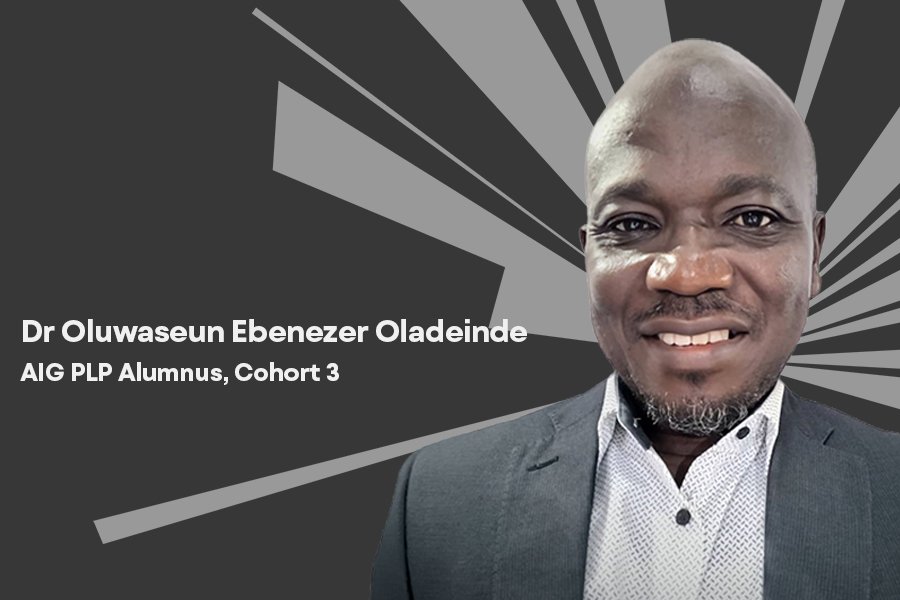
"Having spent nearly two decades at the frontlines of public health in Lagos, I recognised that technical excellence alone was not enough. I needed the capacity for leadership, strategic communication, and reform-minded thinking to drive systemic change. The AIG Public Leaders Programme gave me exactly that."
— Dr Oluwaseun Ebenezer Oladeinde, Director of Planning, Research & Statistics, Lagos State Health District V, Lagos State Ministry of Health.
Dr Oluwaseun Ebenezer Oladeinde has spent close to two decades working at the intersection of public health practice and systems reform in Lagos State. As Director of Planning, Research and Statistics at the Lagos State Health District V, he oversees healthcare performance monitoring, strategic planning, and research coordination across primary healthcare facilities serving four Local Governments.
Inspired by the testimony of a participant of the AIG Public Leaders Programme, he applied with a clear goal: to become a more effective leader and change agent across Nigeria’s public health system.
"The AIG PLP, anchored by the Blavatnik School and championed by the Aig-Imoukhuede Foundation, presented the kind of leadership development training I had been looking for: rigorous, public service-centred, and directly applicable to the realities of public health in a megacity like Lagos," he reflected.
The programme proved to be a turning point for him. The strategic thinking frameworks and adaptive leadership tools he gained have directly shaped his approach to health systems strengthening, Primary Healthcare Centres performance monitoring, and digital health governance. His growth has not gone unrecognised.
Speaking about his reform project, “Strengthening Public Services: Improving Access to Primary Healthcare Services in Igbologun Community of Amuwo-Odofin, Lagos State, Nigeria,” Dr Oladehinde explains how he worked to improve access to primary healthcare in Igbologun, an underserved riverine community in Amuwo-Odofin Local Government Area of Lagos State. Although a primary healthcare facility existed, utilisation was low, immunisation coverage was poor, and many residents remained outside the formal health system due to physical and financial barriers.
To address these challenges, he led a community-driven intervention focused on both demand and supply sides of care. This included raising awareness of the Lagos State Health Insurance Scheme (ILERA EKO) and the Basic Healthcare Provision Fund (BHCPF), engaging community leaders to support enrolment, and strengthening primary healthcare workers’ capacity on BHCPF processes. The project also supported key administrative requirements for BHCPF implementation, improved facility infrastructure, and increased community sensitisation on available services.
“The impact has been visible in service use, preventive care, and financial protection,” he affirmed.
Outpatient attendance at the Igbologun Primary Healthcare Centre increased significantly, reflecting stronger trust and higher utilisation of services. Routine immunisation coverage for children under five also improved, contributing to progress toward district and state health targets. In addition, increased enrolment in the ILERA EKO health insurance scheme reduced out-of-pocket spending for households and eased financial barriers to care.
To sustain these gains, the project strengthened community structures and participation mechanisms, ensuring continued local ownership. The lessons from Igbologun are now being used to inform plans to scale the model to other riverine and hard-to-reach communities in Lagos State Health District V.
Click here to learn more about his reform project.