
Cultivating transformative public leadership for African governance
Author
Eniola Olowu, Deputy Director of Programmes, Aig-Imoukhuede Foundation

Across Africa, the demand for stronger governance continues to grow. Citizens increasingly expect efficient services, transparent institutions, and accountable leadership. Yet public institutions often operate under significant social, economic, and political pressures that limit performance and reform capacity. Closing this governance gap requires more than aspiration. It requires a clear understanding of leadership capability gaps, targeted and context-specific interventions, results-oriented delivery systems, and sustained investment in human capital.
This commitment to strengthening governance systems is the anchor behind the Aig-Imoukhuede Foundation’s partnership with the Blavatnik School of Government (BSG), University of Oxford. The focus is not simply on offering scholarships, but on deliberately identifying high-potential public servants through a rigorous selection process, equipping them with world-class public leadership education, and building a pipeline of reform-minded leaders capable of strengthening public institutions across Africa.
Why Oxford: The logic of our partnership
The partnership with the University of Oxford is anchored in shared purpose and practical relevance. The Blavatnik School of Government’s mission to inspire better government and public policy worldwide closely aligns with our goal of advancing a more effective and accountable African public service.
BSG’s approach bridges theory and practice. It focuses on how policies work in real governance environments, how public resources are managed effectively under constraints, and how institutional trust is built and sustained. For African public servants working within complex systems, this provides both intellectual depth and practical tools for the design and execution of reform.
While African public leaders increasingly throng global institutions of governance training for relevant capacity development opportunities, we opted for a partnership to bring a global institution to connect with high-potential public servants across Africa and to have Nigeria as the global melting pot.

Globally equipped, African-focused
Sustainable public sector reform requires both enabling environments and access to globally relevant knowledge and skills. This thinking informs three flagship initiatives delivered in partnership with BSG : the AIG Public Leaders Programme (AIG PLP), the AIG Scholarships, and the AIG Visiting Fellowship Programme.
The AIG PLP is a pan-African programme designed for middle- to senior-level public servants committed to driving system-level reform. Since 2021, six cohorts have equipped 306 public sector leaders across Nigeria, Cameroon, Ghana, Kenya, Tanzania, Zambia, and South Africa. The programme combines live virtual instruction, an immersive residential experience, self-paced online learning, and, most importantly, the implementation of reform projects directly aligned with participants’ institutional priorities. The AIG PLP is particularly enriched with case studies, discussions of public sector challenges and public in-conversations with African thought leaders as well as public sector executives who share lived experiences that are contextual to the African public service.
Cohort 5, “The Legacy Builders,” recently graduated with 69 actionable reform initiatives ready for implementation across the continent. These include Sarah Ukemenam-Ezendu’s work on incremental adoption of a digital medicine workflow at Wuse District Hospital in Nigeria’s FCT, grounded in a governance-first approach within system constraints. In Zambia, Monica Chipanta Mwansa is addressing inefficiencies in minor procurement processes within the Ministry of Foreign Affairs, while Patricia Luhanga is developing an electoral communication risk management framework for Zambia’s electoral process. In Kenya, Ngele Marcs Kilonzo is driving fiscal discipline reforms through a pending bills clearance framework in Kitui County. In Tanzania, Victoria Mwanri Elangwa is strengthening performance management systems at the Tanzania Fertiliser Regulatory Authority.
The AIG Scholarships Programme has supported 34 public servants through the Blavatnik School’s Master of Public Policy (MPP), strengthening mid-level leadership across Nigerian public institutions. The programme equips scholars with advanced policy analysis tools, global exposure, and leadership development support.
The 2024 scholar, Siaka Salami, has returned to the Nigeria Revenue Services and is applying insights from Oxford to strengthen internal reform processes. He is also mobilising a pan-African network of policy professionals through a public policy conference under the Global Common Initiative, which was conceived during his time at Oxford.
Meanwhile, the 2025 scholar, Pelumi Olugbile of Nigerian Communications Satellite (NIGCOMSAT), is currently immersed in the MPP programme. In a cohort of 141 students from 63 countries, she continues to engage with global perspectives through multidisciplinary learning, case studies, and structured mentorship that supports both personal and professional development.
The AIG Visiting Fellowship Programme has hosted distinguished public leaders, including Professor Attahiru Jega, Justice Georgina Wood, Ifueko Omoigui-Okauru, and Funke Adepoju.
These fellows represent a continuum of leadership development that spans exposure, reflection, and applied reform.
As a 2025 Visiting Fellow, Adepoju has actively engaged with public administration experts at BSG and developed the “Reform-Inspired Systems for Execution (RISE)” model. This framework is designed to translate public sector learning into measurable institutional reform. Through RISE, the Administrative Staff College of Nigeria (ASCON) is positioned to evolve from a traditional training institution into a reform incubation hub. A transformed ASCON would further validate the essence of our global partnership with BSG – African public servants having access to global knowledge, applicable to the local context and delivered by Nigeria’s Premier Management Development Institution.
Across all three initiatives, one principle remains constant: while learning is global, application is local. Alumni return to their institutions across Africa equipped not only with knowledge but with a commitment to apply it in ways that directly advance institutional priorities.
The multiplier effect
Investing in public servants creates a ripple effect that extends far beyond individual beneficiaries. It strengthens institutions and ultimately improves outcomes for citizens.
The impact of the AIG PLP illustrates this multiplier effect. Since 2021, 306 public leaders have returned to their institutions with practical, implementable reform initiatives. These initiatives influence budgeting processes, strengthen accountability systems, improve service delivery, enhance healthcare and resource management, and introduce more efficient procurement and fiscal control systems.
Importantly, these reforms are not theoretical outputs. They are embedded in real institutional contexts and respond directly to operational challenges. The result is a growing culture of evidence-based decision-making and reform-minded leadership within public institutions across Africa.
Ultimately, the value of global education lies in its local application. When public servants are properly equipped and supported, they become catalysts for sustainable institutional change.
The role of African philanthropy
African philanthropy plays a uniquely important role in addressing governance challenges because it understands the institutional, cultural, and political contexts within which public servants operate. This contextual awareness enables more targeted and effective interventions.
At the Aig-Imoukhuede Foundation, we serve as a strategic bridge. We identify high-potential public servants, connect them to globally respected institutions such as the Blavatnik School of Government, and support them as they translate learning into practical reform within their home institutions.
This cycle of local identification, global exposure, and then local application ensures that knowledge does not remain abstract. Instead, it is continuously translated into improved policy design, stronger institutions, and better service delivery outcomes.
A vision for the future
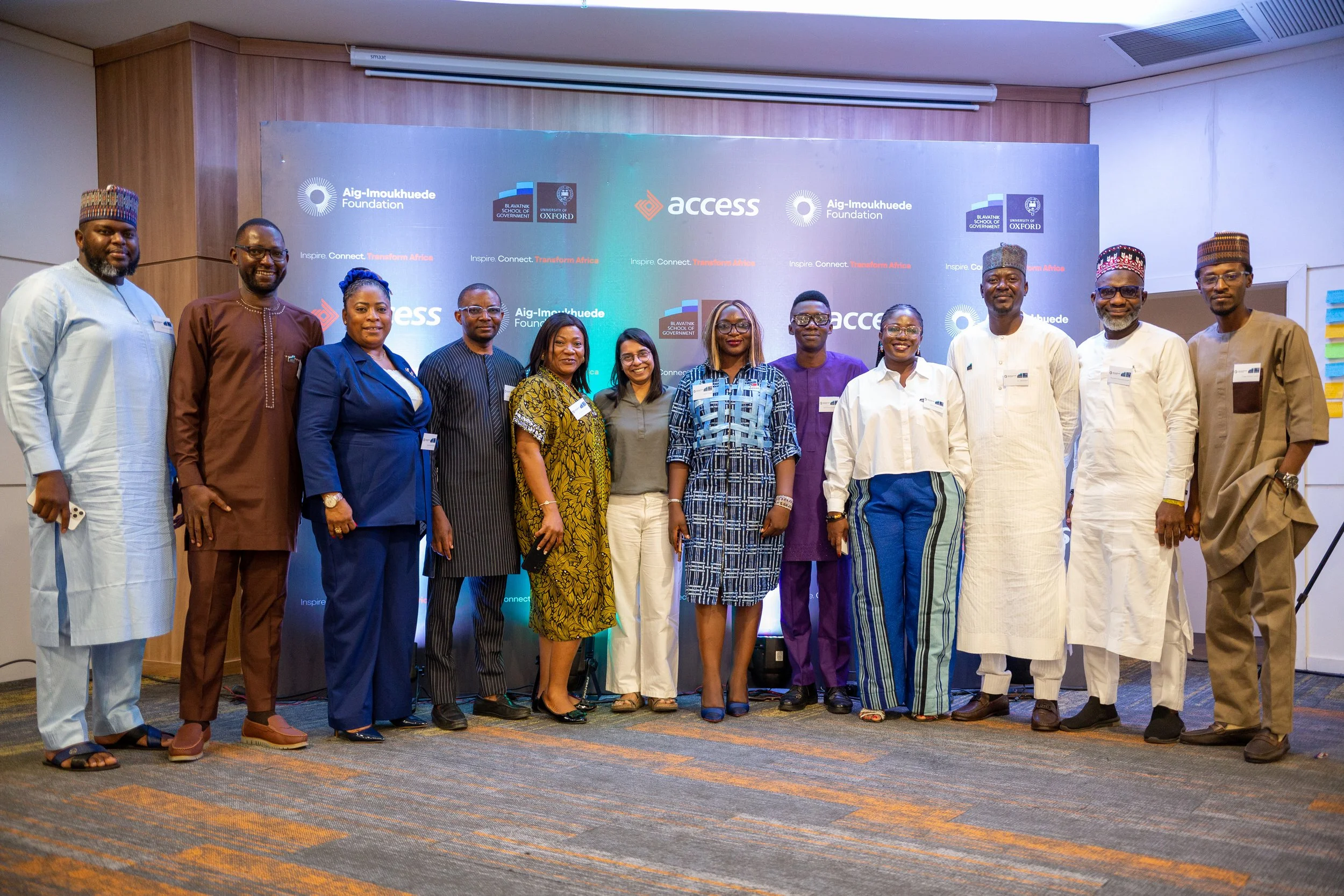
The graduation of the 2025 AIG PLP cohort marks the emergence of 69 new reform initiatives ready for implementation across Africa. These leaders are part of a growing continental network of reform-minded public servants committed to improving governance systems from within.
They also join a broader alumni ecosystem that includes scholars, fellows, and senior public executives who continue to collaborate, mentor, and support one another in advancing institutional reform.
At the Aig-Imoukhuede Foundation, we remain guided by a simple belief: a capable, ethical, and effective public service is fundamental to improving quality of life. Over the next five years, we are committed to developing 3,000 transformative public leaders across Africa.
Conclusion
Bridging Africa’s governance gap requires deliberate, sustained investment in people, institutions, and systems. Through our partnership with the Blavatnik School of Government, we are demonstrating that when high-potential public servants are equipped with global knowledge and supported within their institutional environments, meaningful reform becomes both achievable and sustainable.
As this community of reform leaders continues to grow, we invite the next cohort of public servants and public sector executives to apply for the 2026 AIG Public Leaders Programme and the 2026 AIG Visiting Fellowship Programme. Applications are open.