
Why Leadership Is a Team Sport
Author
Emmanuel Nwanya; Team Lead Alumni Network & Advancement Team, Aig-Imoukhuede Foundation

History has a way of simplifying leadership.
When we think of transformative reforms, we often associate them with a single individual: the President who drove a national agenda, the Governor who transformed a state, or the Chief Executive who turned around an institution. It is an appealing narrative because it gives us a hero to celebrate. Yet beneath almost every enduring reform lies a far more complex story: one of teams working across functions, institutions and sectors to turn vision into reality.
Take Singapore, for example. Lee Kuan Yew is rightly celebrated for his visionary leadership and the country's remarkable transformation. But Singapore was not built by one leader alone. It was shaped by an exceptional team of political leaders, technocrats and public servants, including Dr Goh Keng Swee, who laid the foundations of its economic strategy; S. Rajaratnam, who defined its foreign policy; Lim Kim San, who revolutionised public housing; and countless civil servants who translated bold ideas into effective public institutions. History remembers the face of the transformation, but institutions remember the people who built it together.
This tendency to attribute success to individuals rather than systems is common across both the public and private sectors. We celebrate the visible leader while overlooking the collective effort that makes meaningful change possible. The reality, however, is that leadership has never been a solo endeavour. The more complex the challenge, the more dependent success becomes on collaboration. Leadership, therefore, is less about individual brilliance and more about creating the conditions for others to contribute their expertise towards a shared purpose.
Complex Problems Require Collective Leadership
The challenges confronting governments today are fundamentally different from those of previous generations. They are more interconnected, involving multiple institutions, competing priorities and diverse stakeholders. No single ministry, department or agency possesses all the expertise or authority required to solve them.
Improving educational outcomes, for instance, requires more than effective education policies. It depends on healthcare, nutrition, infrastructure, digital connectivity, teacher development, public finance and social protection. Likewise, strengthening economic growth relies on sound regulation, efficient public institutions, reliable data, investor confidence, security and effective service delivery. Even reforms that appear straightforward on paper often require sustained coordination among numerous actors before citizens experience any tangible improvement.
This complexity changes the nature of leadership itself. The defining question is no longer whether a leader has all the answers, but whether they can bring together people who possess different perspectives, technical expertise and institutional mandates to solve problems collectively.
In many respects, today's public sector requires leaders that are less like commanders directing operations and more like conductors leading an orchestra. Every instrument has a distinct role, but meaningful progress only emerges when they perform in harmony.
What I See in the Classroom:
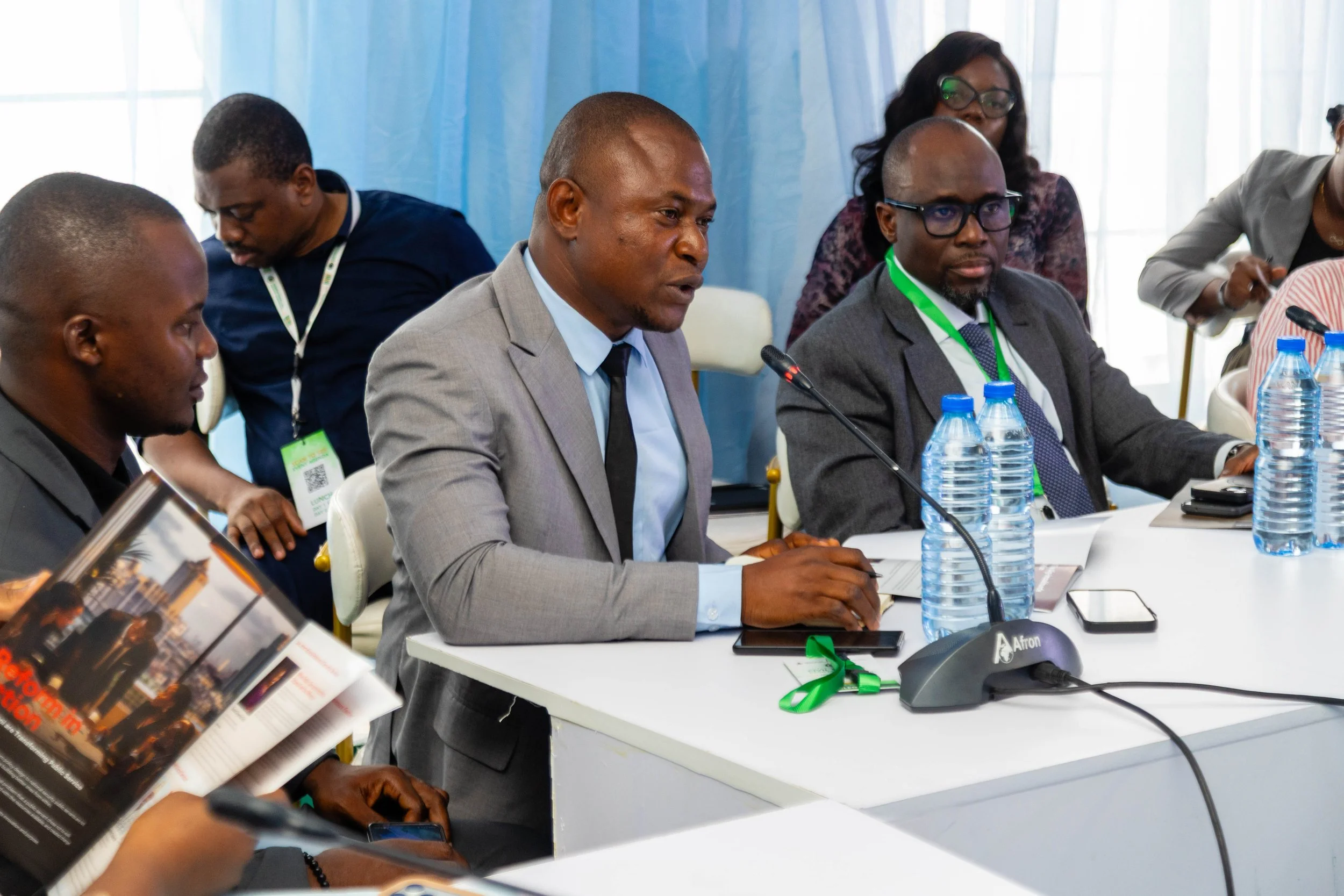
Participants engage in modules on negotiation in the public interest, strengthening public organisations, digital transformation, integrity in public life, and strategic communication, especially storytelling. These provide valuable analytical frameworks. But some of the most meaningful learning happens in the exchanges between participants themselves.
When leaders from different sectors and countries share experiences, a common pattern often emerges. Challenges that appear unique to one institution frequently mirror those faced elsewhere: aligning stakeholders around reform priorities, navigating complex organisational environments, and sustaining momentum for change over time. Through these discussions, participants begin to view reform not simply as a technical exercise, but as a leadership practice.
The Skill of Reading Power:
One exercise illustrates this well. Participants are asked to map the formal decision-making structure within their institutions and then reflect on how decisions are actually influenced and implemented in practice. The two do not always perfectly align.
Somewhere in many organisations, there is a person who holds no senior title but whose opinion shapes outcomes. Somewhere there is a committee that exists on paper but never meets, and a corridor conversation where real decisions are made. Somewhere, there is a stakeholder who will not voice opposition openly, but will quietly ensure that implementation fails.
Reform Is Sustained by Institutions, Not Individuals
Working with public sector leaders over the past few years has reinforced one important lesson for me: successful reforms rarely succeed because of one exceptional individual. They succeed because leaders deliberately build coalitions, create institutional ownership and enable others to lead.
At the Aig-Imoukhuede Foundation, we have had the privilege of engaging our programme alumni who are leading reforms across different public institutions. Although their reform initiatives differ, from digital transformation and public financial management to healthcare, education and regulatory reforms, their experiences reveal a common pattern. The reforms that gain traction are seldom those driven by technical expertise alone. Rather, they are the ones where leaders invest time in securing buy-in from senior management, building multidisciplinary teams, engaging stakeholders early, and creating shared ownership of the reform process.
Conversely, some technically sound initiatives struggle not because the ideas are weak, but because they lack institutional support. Without collaboration, reforms become heavily dependent on one individual. When that individual is transferred, promoted or leaves office, momentum often slows, and in some cases, the reform disappears altogether. This is why institutional capability matters as much as individual capability. Sustainable reform requires systems that outlive their champions.
Leadership Is About Creating the Conditions for Others to Succeed
Many leadership conversations still focus on the qualities of the individual leader—vision, resilience, decisiveness and technical competence. These attributes undoubtedly matter, but they are no longer sufficient.
The most effective leaders I have encountered are distinguished less by their ability to solve every problem themselves and more by their ability to create environments where others are empowered to contribute. They build trust, encourage constructive disagreement, recognise expertise wherever it exists, and create psychological safety for people to speak openly.
This is particularly important in the public sector, where reforms often require collaboration across professional disciplines, organisational boundaries and levels of government. Lawyers, economists, engineers, policy analysts, finance professionals, ICT specialists and frontline service providers each bring unique perspectives that strengthen decision-making. Effective leadership creates room for these perspectives to converge.
Leadership, therefore, becomes less about control and more about coordination. Less about visibility and more about enabling others to perform at their best. Ultimately, the role of a leader is not to become indispensable, but to build teams and systems that continue delivering results even in their absence.
One of Nigeria's most significant public health successes illustrates this point well.
The country's certification as free of wild poliovirus in 2020 was not the achievement of one individual or one institution. It was the result of sustained collaboration among federal and state governments, healthcare workers, epidemiologists, traditional and religious leaders, development partners, logistics teams, community volunteers and data specialists. Each contributed a vital piece of a much larger effort.
Developing Leaders Who Build Teams
If leadership is fundamentally collaborative, then leadership development must evolve accordingly.
For many years, leadership programmes focused primarily on developing individual capability. Technical expertise, strategic thinking and personal effectiveness remain essential, but increasingly they must be complemented by skills such as coalition-building, stakeholder engagement, systems thinking, negotiation and cross-sector collaboration.
This philosophy underpins much of our work at the Aig-Imoukhuede Foundation. Through initiatives such as the Aig-Imoukhuede Public Leaders Programme, the Aig-Imoukhuede Masters in Public Policy and the Aig-Imoukhuede Alumni Network, the Foundation invests not only in strengthening individual leadership capability but also in building communities of reform-minded public servants who continue to learn from one another, support one another and collaborate long after formal training has ended.
This has become increasingly evident through our engagement with alumni across government. Some of the most impactful reforms have emerged not from isolated efforts, but from networks of public servants sharing experiences, connecting colleagues to technical expertise, providing peer support and collaborating across institutional boundaries to solve common challenges.
Leadership development should therefore be viewed as more than preparing individuals for senior positions. It should be about strengthening relationships, networks and collaborative capabilities that enable institutions to deliver better outcomes for citizens.
The Skill of Strategic Patience:
Another recurring lesson concerns the pace of change. Public life rewards action. There is pressure to announce, to launch, to show progress. But reform that moves too fast often collapses. It outruns its coalition, achieves visibility, and then fails.
In public institutions, progress often requires sequencing reforms carefully, building consensus where possible, and recognising that durable change sometimes develops incrementally rather than instantaneously.
The most effective reformers I have watched are not the fastest. They are the ones who understand that timing matters. They know when to wait for a stakeholder to come around. They know when to pilot quietly before scaling publicly. They know that a reform implemented in year three is better than a reform announced in year one and abandoned in year two.
People don’t often applaud leaders for waiting. But waiting, when done strategically, is not passivity. Strategic patience can be as important as urgency.
The Skill of Absorbing Resistance:
Equally important is resilience. Reform initiatives frequently attract scrutiny, differing perspectives, and legitimate debate. Navigating these dynamics constructively while maintaining focus on long-term outcomes is an essential part of public leadership. Perhaps the hardest skill, and the one I think about most often, is the ability to absorb resistance without breaking.
Reform attracts criticism. Some of it is fair. Some of it is not. Either way, it lands on the same person. Day after day. Meeting after meeting. I have watched participants describe moments when they wanted to stop. When the weight of opposition felt heavier than their will to continue. When they questioned whether any of it was worth it. What kept them going, in most cases, was not heroic resolve. It was something smaller. A colleague who listened. A peer who said, “I know that feeling.” A small win that reminded them why they started.
The programme does not give public sector leaders a thick skin, but it gives them something more valuable: a network of people who understand. People who have absorbed the same resistance and kept going. People who can then say, “Keep going,” and mean it.

Redefining Leadership Success
Perhaps it is time we reconsider how we define leadership success.
If our instinct is always to ask, “who transformed this institution?” We risk overlooking the many people whose contributions made that transformation possible. A more useful question might be, “what kind of team, culture and institution made this reform possible?”
The answer to that question often tells us much more about whether change will endure.
As governments confront increasingly complex development challenges, our greatest leadership imperative is not producing more individual heroes. It is building leaders who can build teams, cultivate trust, mobilise diverse stakeholders and create institutions that continue delivering results long after they have moved on.
After all, lasting reforms are rarely the achievement of an extraordinary leader. They are almost always the product of extraordinary teams working together in pursuit of a shared purpose.