
Rethinking Medical Education in Nigeria: Our 2026 Aig-Imoukhuede Visiting Fellow
How can Nigeria train more doctors without compromising the quality of care they deliver?
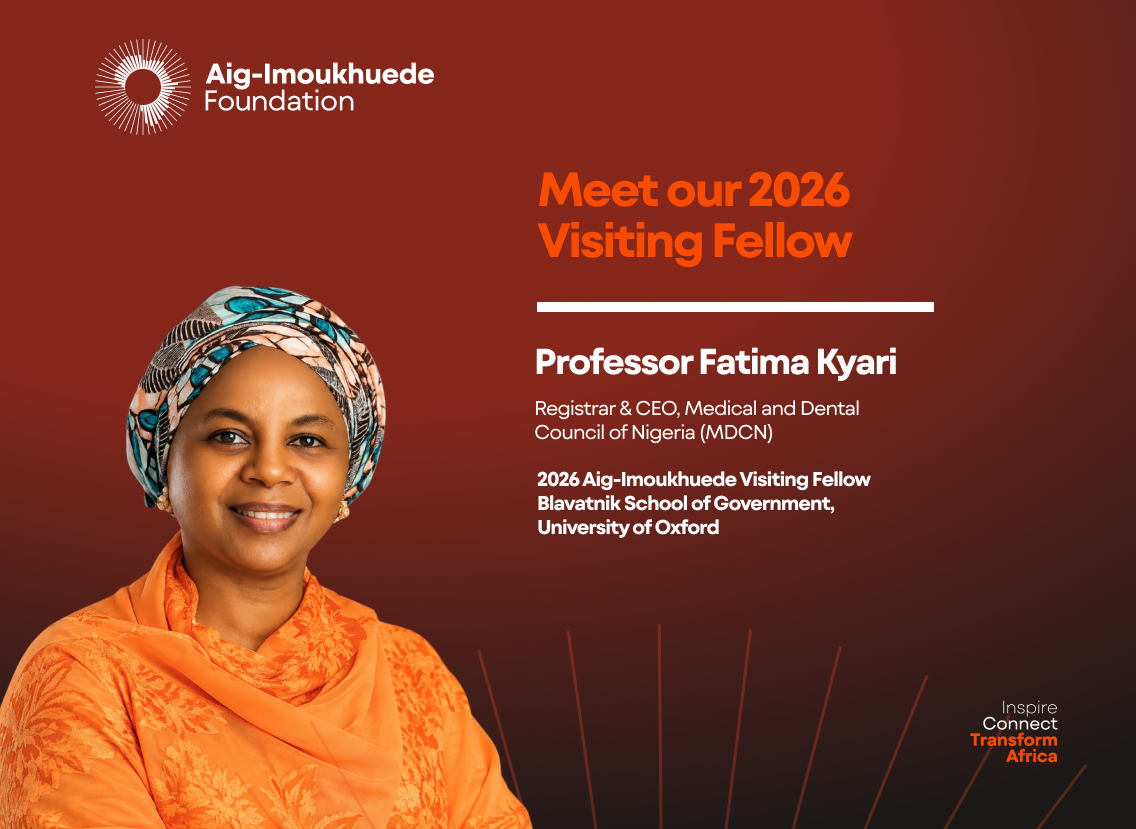
Professor Fatima Kyari, Registrar and Chief Executive Officer of the Medical and Dental Council of Nigeria (MDCN) and our 2026 Aig-Imoukhuede Visiting Fellow, will spend the next six months at the University of Oxford's Blavatnik School of Government exploring this question, treating the rapid growth of the country's medical schools as a public sector reform challenge.
The Aig-Imoukhuede Visiting Fellowship offers distinguished public sector leaders six months of study, reflection and engagement at the University of Oxford’s Blavatnik School of Government, giving them the space to deepen their understanding of critical policy challenges, test new ideas and develop practical solutions for strengthening public institutions. Professor Kyari joins a distinguished line of past Fellows that includes Professor Attahiru Jega, former Chairman of the Independent National Electoral Commission, and Justice Georgina Wood, former Chief Justice of Ghana.
Her Fellowship comes at a pivotal moment for Nigeria's health system. As the country works to expand its health workforce in the face of persistent shortages and the migration of medical professionals, the question of how to train more doctors without lowering standards has become one of the most pressing in public health.
As Registrar and CEO of the MDCN, Professor Kyari sits at the centre of that question. The Council regulates the training and practice of medical doctors and dentists in Nigeria, and her work spans healthcare delivery, medical research, health policy, implementation and institutional reform. She is leading efforts to strengthen medical education, health workforce governance and professional regulation, and she has shown how global evidence can shape national practice, playing a key role in adapting the International Agency for the Prevention of Blindness (IAPB) glaucoma toolkit into Nigeria's national glaucoma management guidelines.
During her Fellowship, Professor Kyari will examine how the rapid expansion of medical schools in Nigeria can be managed as a strategic public sector reform. Her project will explore how the country can strengthen the systems that support the training and deployment of doctors while maintaining quality standards in education and care, and how Nigeria can participate more strategically in the global political economy of health. Drawing on this work, she will develop policy recommendations on governance, regulatory stewardship and implementation.
For Professor Kyari, the Fellowship offers a rare opportunity to step back from the daily demands of regulation and take a wider view of the medical education and health workforce systems Nigeria will need in the years ahead. We look forward to the practical ideas that will emerge from her work and the contribution they will make to a stronger public health system.
Click here to read her full profile.