
Building Smarter Institutions, Not Just Smarter Systems
Lasting change depends not only on sound policy or adequate resources, but on institutions that understand the realities of the people they are meant to serve.
Much of my work at the Aig-Imoukhuede Foundation has centred on strengthening the leaders and institutions responsible for delivering better outcomes for citizens. It has reinforced my belief that sustainable progress is shaped not only by what institutions are trying to achieve, but by how well they understand the people they exist to serve and how effectively they respond to the circumstances of their lives.
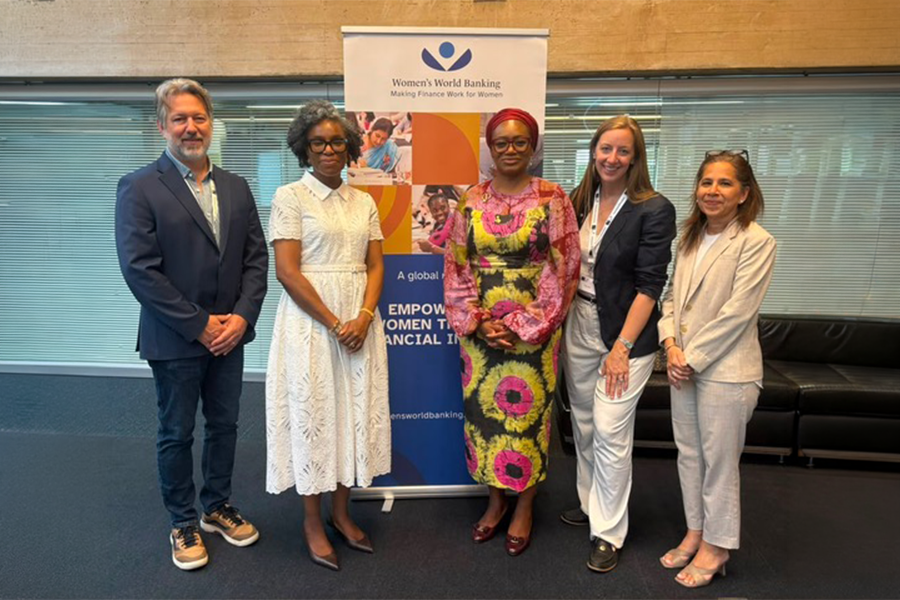
That conviction is one of the reasons I chose to join the Women's World Banking Board. Financial inclusion is not simply about expanding access to financial products. It is about building systems that recognise the realities of people's lives and give them a fair opportunity to participate, grow and thrive.
For women, that challenge is especially important. Across many economies, women continue to navigate financial systems that were not designed with their realities in mind. Their businesses may be structured differently, their incomes may be less regular or predictable, and their responsibilities may place different demands on their time and resources. Yet these realities are often treated as reasons for exclusion rather than factors that institutions understand and design around.
This is one of the reasons I have found the work of Women's World Banking so meaningful. It is a community deeply committed to understanding these gaps and finding practical ways to close them. It also returns me to a question that has shaped much of my work over the years: how do we build institutions that are better able to understand the people they serve?
That question goes well beyond any one sector. Whether we are talking about financial institutions, public institutions, or the systems that support them, good outcomes depend on the willingness and ability of leaders to look beyond processes and policies and ask a more fundamental question: are these systems actually working for the people they are intended to serve?
That was one of the reasons a recent private roundtable convened by Women's World Banking and Infosys at the University of Oxford was so valuable. The discussion brought together development partners and private sector leaders to consider a question that is becoming increasingly important for the future of financial services: how do we ensure that artificial intelligence is inclusive?
The real issue was not simply what AI can do, but who it is being designed to serve.
AI is increasingly being used across financial services, from credit assessment to customer engagement and fraud detection. Yet many of the systems being built today rely on data that does not fully capture women's financial lives. That raises a question more important than whether an AI model is technically accurate.
Who is represented in the data? What behaviours are recognised as evidence of creditworthiness? Whose financial realities are reflected in the assumptions behind these systems? And who is involved in building, testing and governing them?
These questions matter because exclusion can happen long before an algorithm makes a decision. It can begin with the data that is collected. It can sit within the assumptions behind a financial product. It can emerge from the way creditworthiness is defined. It can even be shaped by who is sitting around the table when a system is designed.
For me, one of the clearest messages from the roundtable was that inclusive AI cannot be treated simply as a technology challenge. It is an institutional challenge. It is about whether the organisations adopting these tools are prepared to ask better questions, recognise their own blind spots and take responsibility for the human consequences of the systems they build and use.
As institutions adopt new technologies and respond to increasingly complex challenges, the quality of the leadership behind those decisions becomes even more important. Leaders need to understand not only what a new technology can do, but also the assumptions embedded within it, the people who may be left out, and the consequences of getting those decisions wrong.
This is why leadership development matters. We cannot build better institutions simply by introducing new tools. We also need leaders who can listen to perspectives different from their own, question the design of the systems they oversee, and remain accountable for the outcomes those systems produce. If the people building, procuring, governing and testing these systems do not include diverse perspectives, there is a real risk that AI will reproduce the same blind spots that already exist within our institutions.
The answer is not to slow down innovation. It is to be more intentional about how we innovate and how we lead. That means listening to the people who use our institutions and services. It means bringing more diverse perspectives into decision-making. It means testing whether systems work fairly across different groups. It means being able to explain decisions, particularly when those decisions shape a person's access to opportunity. And it means creating meaningful ways for people to question and correct decisions that affect them.
These are not only questions for the financial sector. They are questions for anyone concerned with building institutions that work better for people.
The promise of AI is significant. It can help institutions reach more people, improve how they deliver services and open new pathways to opportunity. But technology does not automatically make an institution more effective or more inclusive. The quality of our institutions will continue to depend on the quality of the leadership behind them.
For me, that is where the real opportunity lies: not simply in building smarter systems, but in developing the leaders and institutions capable of using them responsibly, questioning them rigorously and ensuring that they deliver better outcomes for the people they are meant to serve.
Authors: Ofovwe Aig-Imoukhuede